
Introduction
Choosing the right WiFi range extender can be surprisingly difficult when two products come from the same manufacturer and offer many similar features. That is exactly the situation with the TP-Link AX1800 vs AX3000 WiFi 6 Range Extender comparison.
The two products being compared here are the TP-Link RE615X AX1800 WiFi 6 Range Extender and the TP-Link AX3000 WiFi 6 Range Extender. Both are dual-band wireless repeaters, both include an Ethernet port, both state support for up to 64 devices, and both are designed to help extend an existing internet connection.
However, there are important differences in their stated wireless class and coverage. The RE615X is described as an AX1800 model with coverage of up to 2,100 sq. ft. (about 195.1 m²), while the AX3000 model is described as providing coverage of up to 2,400 sq. ft. (about 222.97 m²).
That makes the TP-Link AX1800 vs AX3000 WiFi 6 Range Extender decision less about choosing between two completely different products and more about identifying which specification set better matches your requirements.
For readers looking for a broader selection of products, the Product Comparisons pillar provides a useful place to explore additional comparisons.
TP-Link RE615X AX1800:
Check the latest price on Amazon
TP-Link AX3000 WiFi 6 Range Extender:
Check the latest price on Amazon
Table of Contents
TP-Link AX1800 vs AX3000 WiFi 6 Range Extender: Quick Summary
At a glance, the two TP-Link range extenders have several similarities.
| Feature | TP-Link RE615X AX1800 | TP-Link AX3000 WiFi 6 Range Extender |
|---|---|---|
| Wireless class | AX1800 | AX3000 |
| WiFi generation | WiFi 6 | WiFi 6 |
| Coverage stated | Up to 2,100 sq. ft. (about 195.1 m²) | Up to 2,400 sq. ft. (about 223 m²) |
| Maximum devices stated | 64 | 64 |
| Bands | Dual-band | Dual-band |
| Ethernet port | Yes | Yes |
| Setup | App setup | App setup |
| Repeater functionality | Yes | Yes |
| EasyMesh | Listed in supplied title | Not specified in supplied title |
| Best distinction | Lower stated coverage and AX1800 class | Higher AX3000 class and higher stated coverage |
The most obvious difference is the wireless class. The RE615X is an AX1800 model, while the other TP-Link extender is an AX3000 model.
The second major difference is the stated coverage. The RE615X lists up to 2,100 square feet, whereas the AX3000 model lists up to 2,400 square feet.
Both, however, are stated to support up to 64 devices.
TP-Link RE615X AX1800 WiFi 6 Range Extender Overview
The TP-Link RE615X AX1800 is positioned as a WiFi 6 range extender with dual-band wireless capability. Its product title identifies it as an AX1800 model and states coverage of up to 2,100 sq. ft. (about 195.1 m²).
For someone dealing with areas where the existing wireless signal does not reach effectively, the RE615X offers a straightforward extender-focused approach.
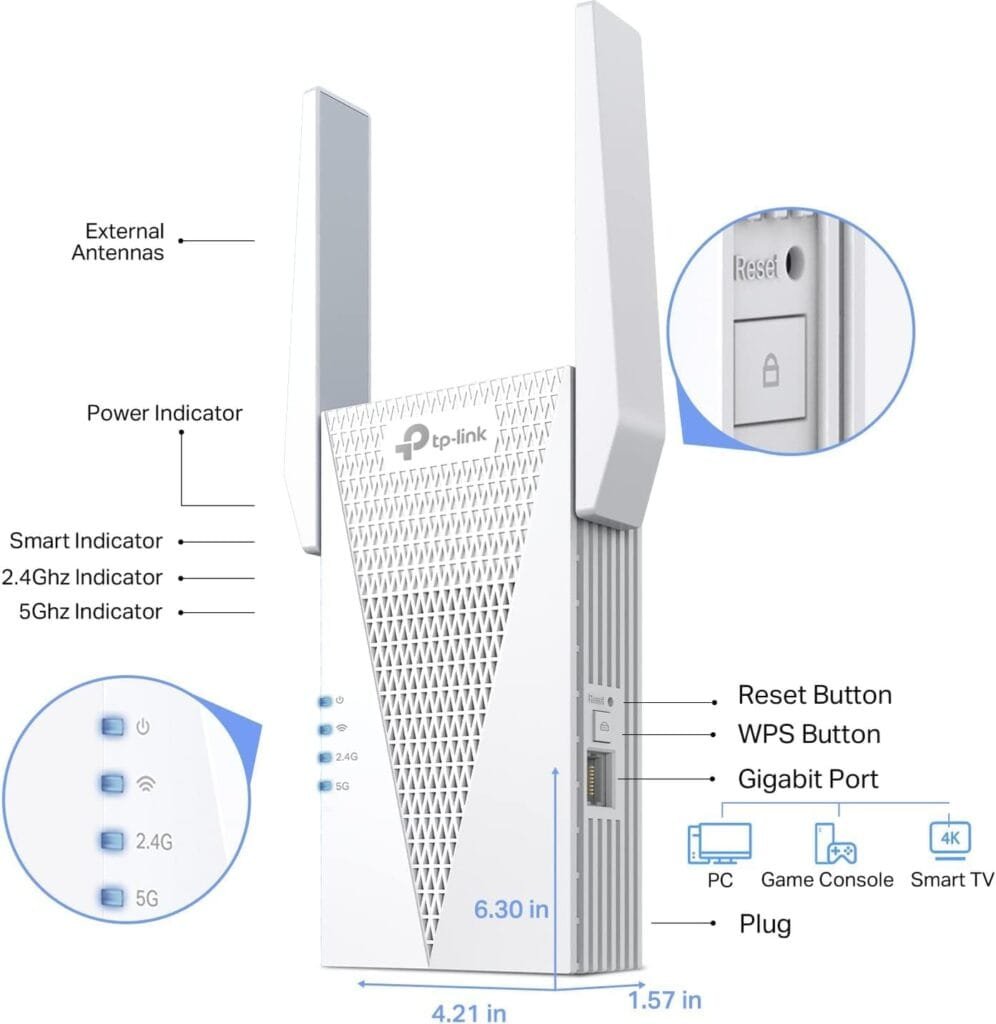
It also includes an Ethernet port. This is useful as a consideration for buyers who specifically want an extender with wired connectivity available rather than relying solely on wireless connections.
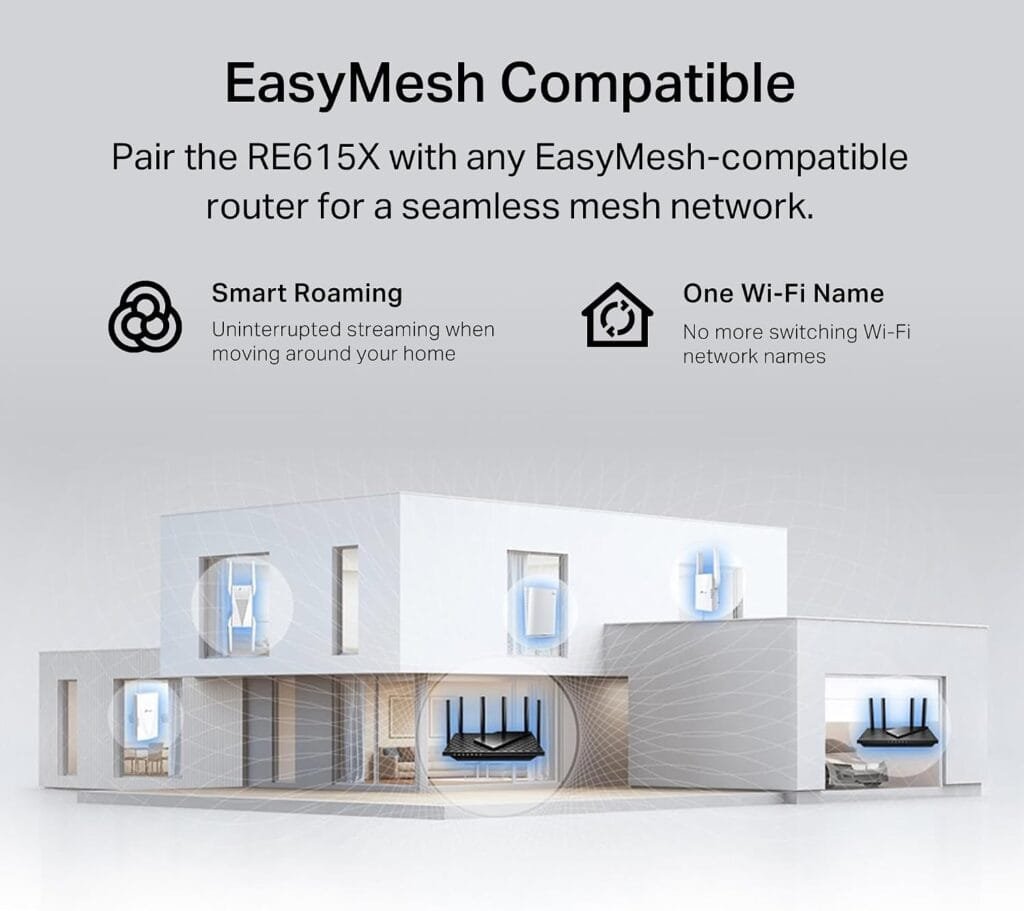
Another notable detail is the inclusion of EasyMesh in the supplied product title. Buyers who specifically want that capability should pay attention to this feature when comparing the two models.
TP-Link RE615X AX1800 Key Features
Based strictly on the supplied product information, the main features include:
- AX1800 WiFi 6 wireless class
- Dual-band wireless connectivity
- Coverage of up to 2,100 sq. ft. (about 195.1 m²)
- Support for up to 64 devices
- Ethernet port
- Internet signal booster functionality
- App-based setup
- EasyMesh
- Wireless repeater functionality
The RE615X therefore makes a compelling comparison point for shoppers who want a TP-Link WiFi 6 range extender without necessarily moving to the AX3000 model.
TP-Link AX3000 WiFi 6 Range Extender Overview
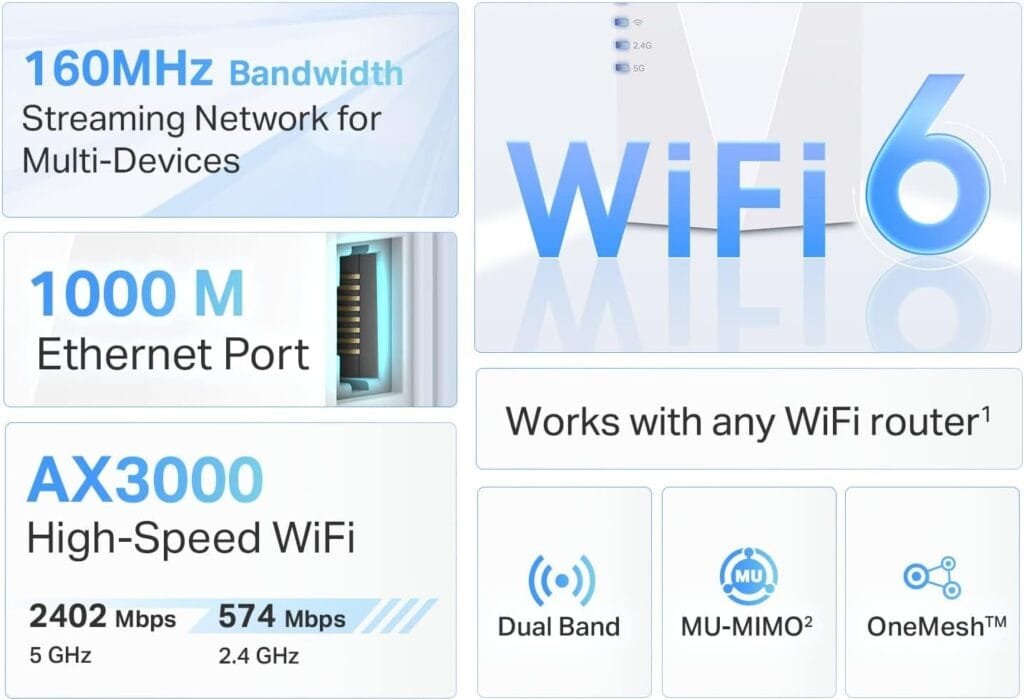
The second product is identified as a TP-Link AX3000 WiFi 6 Range Extender. Its supplied title describes it as a dual-band wireless repeater with an Ethernet port and a stated coverage of up to 2,400 sq. ft. (about 223 m²).
The title also states support for up to 64 devices and includes app setup.
One of its biggest distinguishing points in this comparison is the AX3000 classification. It is positioned above the AX1800 model by wireless class, while its stated coverage is also higher.
The supplied title additionally describes this model as PCMag Editor’s Choice. Because that claim comes directly from the product information provided for this comparison, it can be considered as part of the product’s supplied positioning, but it should not be interpreted here as an independent testing result by this article.
TP-Link AX3000 Key Features
The supplied information identifies the following:
- AX3000 WiFi 6 wireless class
- Dual-band wireless connectivity
- Coverage of up to 2,400 sq. ft. (about 223 m²)
- Support for up to 64 devices
- Ethernet port
- Wireless repeater functionality
- Internet signal booster functionality
- App-based setup
For shoppers prioritising the higher stated coverage figure and AX3000 designation, this model deserves close consideration.
TP-Link AX1800 vs AX3000: Key Differences
The most useful way to understand this comparison is to focus on the differences that are actually stated.
AX1800 vs AX3000
The clearest difference is the wireless class.
The TP-Link RE615X is an AX1800 WiFi 6 extender. The other product is an AX3000 WiFi 6 extender.
That distinction gives the AX3000 model the higher stated wireless class. However, buyers should avoid assuming that the AX3000 designation alone guarantees a particular real-world speed in every environment. Actual networking performance can depend on circumstances that are not supplied in the product information.
For that reason, this comparison focuses on the specifications and capabilities explicitly provided rather than making unsupported performance claims.
Coverage
Coverage is another straightforward difference.
The RE615X states coverage of up to 2,100 sq. ft. (about 195.1 m²).
The AX3000 model states coverage of up to 2,400 sq. ft. (about 223 m²).
That gives the AX3000 model a larger stated coverage figure.
The difference is important for shoppers comparing the products for larger spaces. At the same time, advertised coverage should be treated as a product specification rather than a guarantee that every home or office will receive identical coverage.
Building layout, walls, placement and other environmental factors can affect wireless coverage, so buyers should use the stated figures as a comparison point rather than a promise of identical results in every location.
Device Capacity
Both products state support for up to 64 devices.
This is one area where the comparison does not produce a clear winner based on the supplied specifications.
If device capacity is your main consideration, both products provide the same stated maximum.
That means the decision may come down to other differences, particularly the AX1800 versus AX3000 class and the stated coverage.
Ethernet Connectivity
Both models include an Ethernet port.
That is another similarity worth highlighting because it means buyers looking specifically for a WiFi range extender with Ethernet connectivity can consider either product.
Since no further Ethernet specifications were supplied, this article does not make assumptions about port speed, wired backhaul capabilities or other technical characteristics.
App Setup
Both product titles mention app setup.
For buyers who prefer an app-based approach to setting up networking equipment, this is another common feature between the two products.
The presence of app setup also makes it unnecessary to choose between these two models based solely on whether an app is available.
EasyMesh
The supplied title for the RE615X specifically includes EasyMesh.
EasyMesh is not listed in the supplied title for the AX3000 product, so this comparison cannot claim that the second model does or does not support it.
This is an important distinction because buyers who specifically require EasyMesh should verify the compatibility and support details for the exact AX3000 model before purchasing.
Feature Comparison: TP-Link RE615X vs AX3000
A simple table makes the decision easier.
| Buying Factor | TP-Link RE615X AX1800 | TP-Link AX3000 |
|---|---|---|
| WiFi generation | WiFi 6 | WiFi 6 |
| Wireless class | AX1800 | AX3000 |
| Stated coverage | Up to 2,100 sq. ft. (about 195.1 m²) | Up to 2,400 sq. ft. (about 223 m²) |
| Stated device capacity | Up to 64 | Up to 64 |
| Dual-band | Yes | Yes |
| Ethernet port | Yes | Yes |
| App setup | Yes | Yes |
| Wireless repeater | Yes | Yes |
| EasyMesh | Yes, listed in supplied title | Not specified in supplied title |
| Stated positioning | WiFi 6 range extender | WiFi 6 range extender, PCMag Editor’s Choice listed in title |
The table shows that the products share many characteristics. The biggest differences are their AX classifications, stated coverage and the inclusion of EasyMesh in the RE615X product description.
Which TP-Link WiFi 6 Range Extender Is Best for You?
There is no need to make the choice more complicated than the supplied specifications allow.
Choose the TP-Link RE615X AX1800 If…
The RE615X may be the more appropriate choice if your priorities include:
- An AX1800 WiFi 6 range extender
- Stated coverage of up to 2,100 sq. ft. (about 195.1 m²)
- Support for up to 64 devices
- Dual-band wireless connectivity
- An Ethernet port
- App setup
- EasyMesh listed as part of the product offering
It is particularly worth considering if EasyMesh is an important part of your buying decision.
Choose the TP-Link AX3000 If…
The AX3000 model may be more appealing if your priorities include:
- An AX3000 WiFi 6 range extender
- Stated coverage of up to 2,400 sq. ft. (about 223 m²)
- Support for up to 64 devices
- Dual-band wireless connectivity
- An Ethernet port
- App setup
- A product described as PCMag Editor’s Choice in the supplied title
The higher stated coverage is particularly relevant for buyers comparing these models on the basis of the advertised coverage area.
Who Is the TP-Link RE615X Best For?
The TP-Link RE615X is worth considering for users who want a WiFi 6 range extender with an AX1800 classification and stated coverage of up to 2,100 sq. ft.
It can also be attractive to shoppers specifically looking for EasyMesh, because that feature is explicitly included in the supplied product title.
The Ethernet port adds another useful point of flexibility for buyers who want wired connectivity available on their extender.
Who Is the TP-Link AX3000 Best For?
The AX3000 model is worth considering for buyers who want the higher AX3000 wireless classification and higher stated coverage of up to 2,400 sq. ft.
Its support for up to 64 devices matches the RE615X, so the decision does not need to be based on device capacity.
Instead, buyers can focus on the AX3000 designation, coverage figure, Ethernet port, app setup and the other information supplied for this particular model.
Buying Considerations Before Choosing
A good TP-Link range extender comparison should not focus only on the largest number in the product title.
Start with the size of the area you want to cover. The supplied figures give the RE615X a maximum stated coverage of 2,100 sq. ft. (about 195.1 m²), while the AX3000 model lists 2,400 sq. ft. (about 223 m²).
Next, consider wireless class. If the distinction between AX1800 and AX3000 matters to your networking requirements, this is one of the clearest differences between the products.
Then consider connectivity. Both models include an Ethernet port and dual-band wireless functionality.
Device capacity is less decisive because both are stated to support up to 64 devices.
Finally, consider features that are specifically important to your network. EasyMesh is explicitly listed for the RE615X, while it is not specified in the supplied title for the AX3000 model.
Value for Money Considerations
Price has deliberately not been used as a deciding factor in this comparison because no current prices were supplied, and Amazon pricing can change.
Instead, value should be considered in relation to the features that matter most to you.
If the AX1800 classification, 2,100 sq. ft. (about 195.1 m²) stated coverage and EasyMesh are sufficient for your needs, the RE615X may offer the feature combination you are looking for.
If the higher AX3000 classification and 2,400 sq. ft. (about 223 m²) stated coverage are more important, the AX3000 model may be the more suitable option.
The key is to avoid paying for capabilities you do not need while also avoiding a purchase that does not match your coverage requirements.
Pros and Cons
TP-Link RE615X AX1800 Pros
- WiFi 6 technology
- AX1800 classification
- Up to 2,100 sq. ft. (about 195.1 m²) stated coverage
- Supports up to 64 devices
- Dual-band wireless
- Ethernet port
- App setup
- EasyMesh listed in the supplied product title
TP-Link RE615X AX1800 Cons
- Its stated coverage is lower than the AX3000 model
- It has an AX1800 rather than AX3000 classification
- Buyers seeking the higher stated coverage may prefer the AX3000 model
TP-Link AX3000 Pros
- WiFi 6 technology
- AX3000 classification
- Up to 2,400 sq. ft. (about 223 m²) stated coverage
- Supports up to 64 devices
- Dual-band wireless
- Ethernet port
- App setup
- PCMag Editor’s Choice is included in the supplied product title
TP-Link AX3000 Cons
- EasyMesh is not specified in the supplied product title
- It has the same stated 64-device capacity as the RE615X
- Buyers who specifically need the features listed for the RE615X should verify whether they are supported on this exact model
Frequently Asked Questions
Is the TP-Link AX3000 better than the AX1800?
The AX3000 model has a higher wireless classification and higher stated coverage than the AX1800 RE615X. However, the better choice depends on which specifications and features matter most to your network.
What is the coverage of the TP-Link RE615X?
The supplied product information states coverage of up to 2,100 sq. ft. (about 195.1 m²).
What is the coverage of the TP-Link AX3000 WiFi 6 Range Extender?
The supplied product title states coverage of up to 2,400 sq. ft. (about 223 m²).
Do both TP-Link extenders support 64 devices?
Yes. Both supplied product descriptions state support for up to 64 devices.
Do both TP-Link range extenders have an Ethernet port?
Yes. Both product titles specify an Ethernet port.
Does the TP-Link RE615X support EasyMesh?
EasyMesh is explicitly listed in the supplied product title for the TP-Link RE615X. The supplied title for the AX3000 model does not specify EasyMesh, so buyers should verify the exact compatibility requirements for that model before purchasing.
Final Verdict: TP-Link AX1800 vs AX3000 WiFi 6 Range Extender
The TP-Link AX1800 vs AX3000 WiFi 6 Range Extender decision comes down to a relatively clear set of differences.
The TP-Link RE615X AX1800 offers WiFi 6, dual-band wireless, an Ethernet port, app setup, support for up to 64 devices, stated coverage of up to 2,100 sq. ft. (about 195.1 m²), and EasyMesh listed in the supplied product information.
The TP-Link AX3000 WiFi 6 Range Extender moves to an AX3000 classification and provides higher stated coverage of up to 2,400 sq. ft. (about 223 m²). It also supports up to 64 devices, includes dual-band wireless, an Ethernet port and app setup.
So, if your priority is the higher AX3000 classification and higher stated coverage, the AX3000 model is the stronger match on those specific specifications.